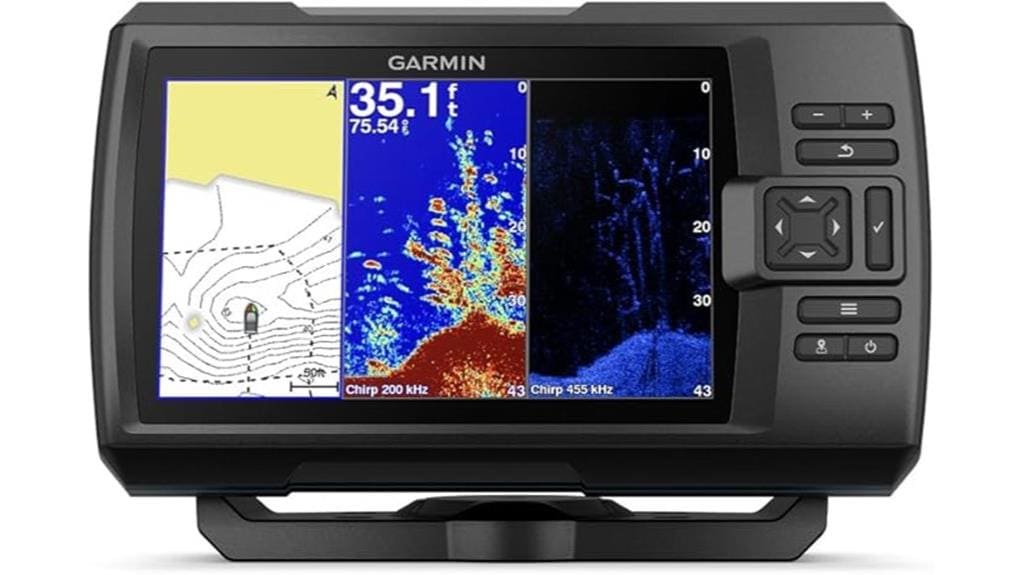
You’ll find the Striker Plus 7cv easy to set up and use on small boats, with a responsive 7″ capacitive screen and fast GPS lock for reliable waypoints and routes. CHIRP gives clear fish arches and depth detail, while ClearVü offers near-photo side views for structure in shallow water—run both together for best ID. Battery life and mounts suit full days on the water. Keep going and you’ll get full test notes and practical tips.
Some Key Takeaways
- Combines CHIRP and ClearVü sonar for detailed fish arches and near-photographic side imaging in real-world fishing.
- 7″ capacitive touchscreen is responsive and easy to use for route entry, waypointing, and menu navigation.
- Built-in GPS with Quickdraw Contours creates real-time 1′ depth maps and reliable waypoint/route accuracy.
- Included transducer and mounts install quickly; check alignment to avoid skewed sonar returns.
- Good battery life (~16 hours) and solid connectivity, but lacks advanced charts and extensive networking.
Real-World Setup and First Impressions of the Striker Plus 7cv
When you unbox the Striker Plus 7cv, you’ll notice the package includes the CV20-TM transducer, both transom and trolling-motor mounts, the power/data cable, a tilt/swivel mount, and the documentation—everything needed for a basic install on most small boats. You’ll mount the unit quickly; check mounting alignment carefully to avoid skewed sonar returns. The touchscreen is capacitive and the screen responsiveness feels immediate during route entry and menu changes. GPS locks fast. Cable routing and mount choices determine long-term freedom on the water, so position for visibility and minimal obstruction without improvising unstable brackets or poor angles. This setup pairs well with kayak fish finder mounts for stable, hands-free use on small craft.
How CHIRP and ClearVü Performed on Shallow and Deep Water
Typically, you’ll see CHIRP and ClearVü behaving quite differently depending on depth: CHIRP gives you detailed fish arches and bottom definition in both shallow and deep water, while ClearVü paints a near-photographic side/forward view that excels at structure and schooling identification in shallow to moderate depths. You’ll notice CHIRP’s signal clarity and noise suppression hold up better at depth, preserving detail resolution on thermoclines and suspended targets. ClearVü delivers superb range performance across structure in shallow water but loses some fine vertical detail deeper down. Use both modes together to maximize target ID and confidence on the water. Many anglers pair sonar with waterproof camera housings to document catches and structure for post-trip analysis.
GPS, Mapping, and Quickdraw Contours Tested on the Boat
Because the Striker Plus 7cv combines a built-in GPS with Quickdraw Contours, you can mark waypoints, plot routes, and record sonar-linked depth data without extra hardware. On the boat you’ll find waypoint accuracy to be solid for recreational fishing—positions lock quickly and hold during turns. Creating contours in real time felt efficient; the unit stitched depth points into readable 1′ lines across runs. Contour editing user experience is basic but functional: you can’t do deep GIS tweaks on-screen, but you can trim and save maps, then share via the Quickdraw Community. Overall, mapping is empowering and reliably practical. This makes the unit a great fit for kayak anglers who want compact, capable electronics for on-water adventures.
Battery, Connectivity, Mounts, and Day-to-Day Usability Notes
After spending time mapping and saving contours, you’ll notice the Striker Plus 7cv’s everyday usability hinges on a few practical details: power management, connectivity reliability, and how the included mounts fit your boat. You get about 16 hours typical run time, so Battery longevity matches long days afloat but you’ll still plan charging for multi-day trips. Wi‑Fi and ActiveCaptain transfers work reliably for waypoint sync and updates, though range depends on your phone. The package’s transom and tilt/swivel mounts install quickly; Mount durability feels solid for regular use. Controls and screen stay intuitive, letting you stay mobile and self-reliant. The unit pairs well with other kayak essentials like marine compasses commonly used by paddlers for navigation.
Who Should Buy the Striker Plus 7cv : Pros, Cons, and Buying Alternatives
If you mainly fish freshwater from a small boat, kayak, or jon boat and want easy-to-use sonar plus onboard mapping without paying for a chartplotter, the Striker Plus 7cv is a sensible pick: it gives you clear CHIRP and ClearVü imaging, a bright 7″ touchscreen, built-in GPS for waypoints and routes, and Quickdraw Contours to record detailed 1′ maps on the go. You should buy it if you’re a budget angler seeking reliable imaging and self-mapping freedom, or a tournament hopeful needing straightforward waypoints. Pros: simple UI, included transducer, Quickdraw. Cons: no detailed charts, limited networking. Alternatives: higher-end Garmin Echomap, Humminbird models. Many kayak anglers also appreciate lightweight, portable setups and accessories that enhance on-the-water convenience, such as portable fish finders.
Some Questions Answered
Does the Unit Support NMEA 2000 or NMEA 0183 Networking?
No, it doesn’t support NMEA 2000 or NMEA 0183 networking. You’ll rely on built‑in GPS and Wi‑Fi (ActiveCaptain) for connections. For NMEA troubleshooting, check cables, settings, and firmware, but don’t expect serial network ports. For Network compatibility with chartplotters or sensors, you’ll need adapters or a separate hub that translates NMEA to Garmin’s interfaces. You’ll want detailed specs and adapter compatibility before buying or wiring.
Can I Upgrade the Display to a Larger Screen Later?
No — you can’t simply swap the Striker Plus 7cv’s display for a larger one; the unit isn’t designed for easy screen upgradeability. If you want a bigger view, you’ll need to replace the whole head unit or add an aftermarket display that supports Garmin sonar output via compatible networking. That means checking for NMEA or proprietary connections, power, and mounting. You’ll want to plan wiring, dash space, and feature parity beforehand.
Is the Transducer Mount Compatible With My Kayak Hull Material?
Yes — the included CV20-TM transducer mounts to most hulls, but you’ll want to check compatibility with rubber hulls and composite lamination. You can use the transom or trolling motor mounts on rigid, flat sections; rubber or thin-shelled inflatable areas may need reinforcement or an adhesive pad. For composite-laminated kayaks, confirm thickness and bonding surface. If unsure, test-fit and reinforce with marine-grade backing or consult the manufacturer.
Does It Come Preloaded With Freshwater Lake Maps?
No, it doesn’t come preloaded with detailed freshwater lake maps. You get built‑in GPS and Quickdraw Contours to create and store your own 1′ contour maps as you fish, and you can join the Quickdraw Community to access others’ data. There’s no dedicated card slots for extra maps on this unit, so you’ll rely on Wi‑Fi transfers via the ActiveCaptain app and internal storage to manage and share your contours.
Can I Use an External GPS Antenna for Improved Accuracy?
No — you can’t add an external antenna to the Striker Plus 7cv; it relies on its built‑in GPS. If you’re chasing an accuracy boost, you’ll need a different unit or external receiver that interfaces via NMEA/USB and supports map/GPS input. Practically, that means upgrading to a chartplotter with antenna input or using a separate GNSS receiver paired to your mobile app or head unit. That gives you true positional improvement and freedom to customize.


